
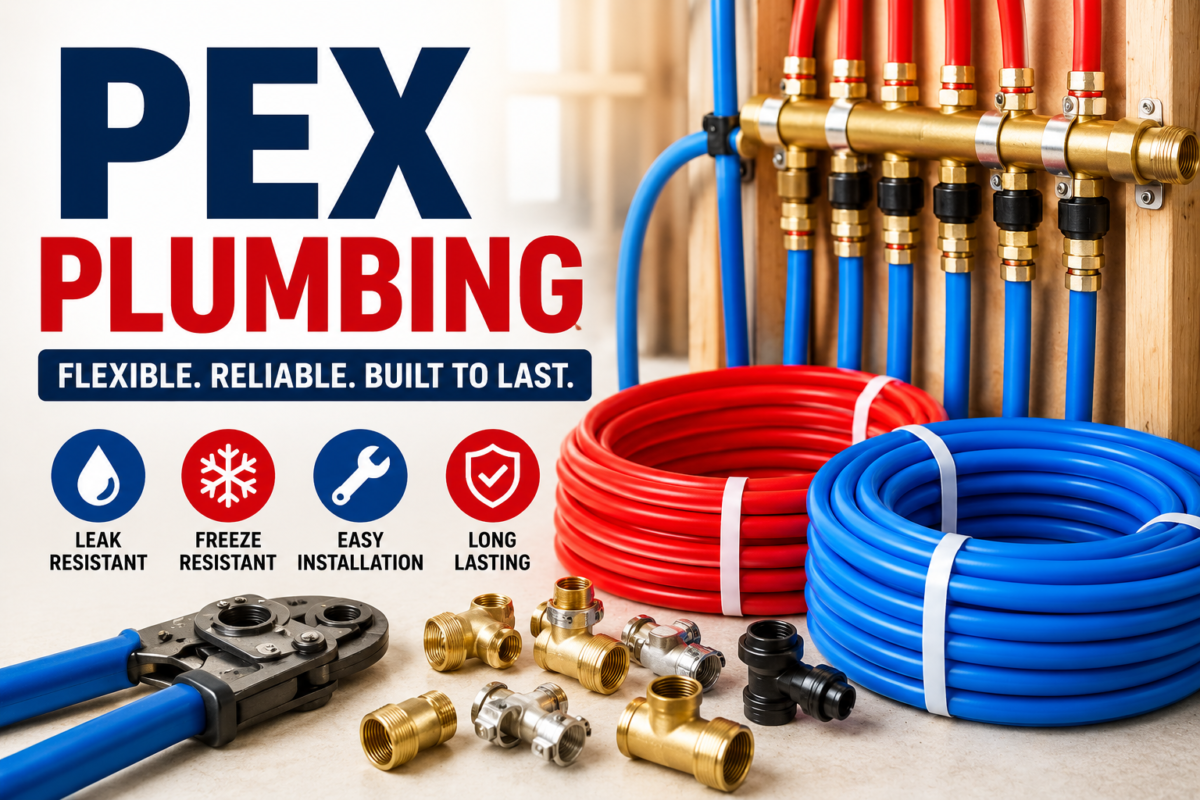
If you’re renovating your home, building a new one, or dealing with aging copper pipes, you’ve probably heard the term PEX plumbing. It’s everywhere in modern construction, and for good reason. PEX pipe is flexible, affordable, freeze-resistant, and remarkably easy to install compared to traditional copper or galvanized steel. This ultimate guide covers everything from what PEX actually is to the different types, installation steps, safety tips, pros and cons, and answers to the most common questions homeowners ask.
What Is PEX Plumbing?
PEX stands for cross-linked polyethylene, a type of flexible plastic tubing used in residential and commercial water supply plumbing systems. The “cross-linking” process strengthens the molecular bonds in the polyethylene, making it far more durable, heat-resistant, and pressure-tolerant than standard plastic pipe.
PEX was first developed in Europe in the 1960s and became widely adopted in the United States from the 1980s onward. Today, it is one of the most commonly used materials in new home plumbing, radiant floor heating, and pipe replacement projects.
Types of PEX Pipe: A, B, and C Explained
Not all PEX is the same. There are three main types, each made using a different cross-linking process:
PEX-A
- Made using the Engel method (peroxide cross-linking)
- Most flexible of the three types
- Best freeze resistance expands and recovers without cracking
- Easiest to install around tight corners
- Slightly more expensive than PEX-B and PEX-C
PEX-B
- Made using the silane method (moisture cross-linking)
- Slightly stiffer than PEX-A but still highly flexible
- Excellent resistance to chlorinated water
- Most widely available and budget-friendly
- Best choice for general residential plumbing
PEX-C
- Made using electron beam irradiation
- Most rigid of the three types
- Good chemical resistance
- Less commonly used in residential plumbing
- Better suited for industrial or specialty applications
| Feature | PEX-A | PEX-B | PEX-C |
|---|---|---|---|
| Flexibility | Highest | Medium | Lowest |
| Freeze Resistance | Best | Good | Good |
| Cost | Higher | Budget-friendly | Mid-range |
| Chlorine Resistance | Good | Excellent | Good |
| Best Use | Cold climates, tight spaces | General home plumbing | Commercial/industrial |
Benefits of PEX Plumbing
PEX offers a wide range of advantages over copper, galvanized steel, and CPVC pipes:
- Cost-effective: PEX materials typically cost 25 to 50% less than copper pipe, and installation labour costs are also lower due to fewer required fittings
- Flexible and lightweight: PEX can bend around corners without elbows, reducing the number of joints and potential leak points
- Freeze-resistant: PEX expands under freezing temperatures rather than cracking, a major advantage in cold climates
- Corrosion-proof: Unlike copper, PEX doesn’t rust, corrode, or react with acidic water
- Quiet water flow: PEX dampens the sound of water hammer and reduces noisy pipe vibration
- Energy-efficient: Its low thermal conductivity means hot water retains heat longer, reducing energy consumption
- Long lifespan: PEX pipe is rated to last 50 years or more under normal conditions
- Safe for drinking water: PEX is approved by the National Sanitation Foundation (NSF) for use in potable water systems. It is lead-free and bacteria-resistant
PEX vs Copper vs CPVC: Which Is Best?
| Factor | PEX | Copper | CPVC |
|---|---|---|---|
| Cost | Low | High | Medium |
| Flexibility | High | Low (rigid) | Low (rigid) |
| DIY Friendly | Yes | Requires soldering | Moderate |
| Freeze Resistance | Excellent | Poor | Poor |
| Lifespan | 50+ years | 50 to 70 years | 25 to 40 years |
| Corrosion Resistance | Excellent | Moderate | Good |
| UV Resistance | Poor (must be covered) | Good | Moderate |
Where Can PEX Plumbing Be Used?
PEX is an incredibly versatile material used in multiple applications:
- Hot and cold water supply lines in residential homes
- Radiant floor heating systems: PEX is the go-to pipe for hydronic underfloor heating
- Outdoor snowmelt systems are buried beneath driveways and walkways
- Water service lines from the main supply to the home
- Plumbing retrofits running new lines through existing walls without major demolition
- Ice maker lines, dishwashers, and washing machine connections⚠️ Note: PEX should not be used for outdoor above-ground applications where it will be exposed to direct sunlight, as UV rays degrade the material over time.
How to Install PEX Plumbing: Step-by-Step
Tools You’ll Need:
- PEX pipe cutter or ratchet cutter
- Crimping tool or expansion tool (depending on PEX type)
- Crimp rings or expansion rings
- Go/No-Go gauge (to verify crimp quality)
- Drill with a long spade or ship auger bit
- Steel nail plates (to protect pipes through studs)
- Pipe clips or staples for securing runs
Step 1: Plan Your Layout
Before cutting a single piece of pipe, sketch out your plumbing layout. Decide whether you’ll use a home run manifold system (individual lines from a central manifold to each fixture) or a trunk-and-branch system (one main line with branches). The manifold system is preferred for PEX as it minimizes fittings.
Step 2: Cut PEX to Length
Use a dedicated PEX pipe cutter for clean, square cuts. Avoid using standard box cutters or saws as they can leave jagged edges that compromise the seal. Mark your measurements clearly with a marker before cutting.
Step 3: Choose Your Connection Method
There are three main ways to connect PEX fittings:
- Crimp method: Slide a copper crimp ring over the pipe, insert the fitting, then use a crimping tool to compress the ring. Use a Go/No-Go gauge to verify. This is the most common method.
- Clamp (cinch) method: Uses a stainless steel clamp ring that’s tightened with a clamp tool. Works with the same fittings as crimp rings.
- Expansion method (PEX-A only): Use an expansion tool to widen the pipe end, insert the fitting, and let the pipe’s memory contract around it. Creates the strongest, most leak-proof connection.
- Push-fit connectors (e.g., SharkBite): Simply push the pipe into the fitting, no tools required. Best for repairs or tight spaces, though slightly more expensive.
Step 4: Route the Pipes
- Drill holes through studs and joists using a 7/8-inch spade bit for 1/2-inch PEX
- Keep bends gradual, PEX has a minimum bend radius (typically 8x the pipe diameter)
- Avoid sharp kinks, which restrict water flow
- Where pipes pass through studs, install steel nail plates to prevent accidental puncture from screws or nails
Step 5: Secure the Pipe Runs
- Use plastic pipe clips or staples every 32 inches on horizontal runs
- Allow slight slack in the lines for thermal expansion and contraction
- Keep hot and cold lines at least 1/4 inch apart or insulate them separately
Step 6: Connect to the Water Heater and Fixtures
- Transition from PEX to copper or threaded connections near the water heater using push-fit adapters or sweat adapters
- Connect to fixture shutoff valves using PEX-to-threaded fittings
- Install water hammer arresters at washing machines and dishwashers
Step 7: Pressure Test the System
Before closing up walls, pressure test your new PEX system:
- Cap all open ends
- Pressurise the system to 80 to 100 PSI using an air compressor
- Wait 15 to 30 minutes and watch for pressure drops
- Check each connection visually for any movement
Step 8: Insulate and Protect
- Insulate PEX pipes in unconditioned spaces (basements, crawlspaces, garages) with foam pipe insulation to prevent freezing
- Never leave PEX exposed to direct sunlight outdoors
Safety Tips for PEX Plumbing
- Always use NSF-certified PEX pipe for drinking water lines. Look for NSF-61 or NSF-14 markings on the pipe
- Do not use PEX in direct sunlight. UV exposure breaks down the material and shortens its lifespan significantly
- Use the correct fittings. PEX-A fittings are not interchangeable with PEX-B fittings. Mixing types compromises the seal
- Check local building codes. PEX is approved in most of the US, UK, and EU, but some older jurisdictions may have specific requirements
- Never connect PEX directly to a gas appliance. PEX is for water supply and radiant heating only, never for gas lines
- Use steel nail plates wherever PEX runs through wooden framing to prevent accidental nail or screw punctures
- Verify every crimp with a Go/No-Go gauge before closing up walls. A bad crimp that is not caught early will eventually leak
Common PEX Plumbing Mistakes to Avoid
- Over-bending the pipe: Kinking PEX permanently restricts flow. Use bend supports or elbows in tight corners
- Skipping the pressure test: Never close up walls until you’ve confirmed there are no leaks under pressure
- Using the wrong crimp tool size: A 1/2-inch crimper will not work on 3/4-inch rings. Always match the tool to the pipe size
- Connecting PEX too close to the water heater: PEX requires a minimum 18-inch gap from the water heater outlet. Use copper or a heat-rated transition fitting for the first section
- Not allowing for expansion: PEX expands and contracts with temperature changes. Leave a small amount of slack in long runs
PEX Plumbing for Radiant Floor Heating
One of the most popular uses of PEX beyond regular plumbing is radiant floor heating. In this system:
- PEX tubing is embedded in or beneath a concrete slab or subfloor
- Hot water is circulated through the loops by a boiler or water heater
- Heat radiates upward evenly across the floor surface
- The system is silent, efficient, and extremely comfortable
PEX-A is the preferred choice for radiant heating because its superior flexibility allows for tight loop configurations without kinking. Typical loop spacing is 9 to 12 inches apart for concrete slabs and 6 to 8 inches apart for staple-up under-subfloor systems.
How Long Does PEX Plumbing Last?
PEX pipe carries a typical manufacturer’s warranty of 25 years, but real-world performance data suggests properly installed PEX lasts 50 years or more under normal indoor conditions. The key factors affecting lifespan are:
- Avoiding UV exposure
- Using NSF-certified pipe for drinking water
- Ensuring proper installation with quality fittings
- Protecting pipes in freezing environments with insulation
How to Repair PEX Pipe
If a PEX pipe develops a leak or gets damaged:
- Locate the damaged section and mark it on both sides
- Cut out the damaged portion using a PEX cutter
- Install a repair coupling, either a crimp coupling or a push-fit SharkBite coupling
- Restore water pressure and check for leaks
- Re-insulate if the pipe is in a cold area
Push-fit couplings are the fastest repair option, taking less than 5 minutes with no tools other than a pipe cutter.
Frequently Asked Questions on PEX Plumbing
Is PEX plumbing safe for drinking water?
Yes. PEX pipe that carries the NSF-61 certification is fully approved for use in potable (drinking) water systems. It is lead-free and does not leach harmful chemicals under normal conditions.
Can I install PEX plumbing myself?
Yes, PEX is one of the most DIY-friendly plumbing systems available. The crimp and push-fit methods require no soldering or special skills. However, always check your local building codes and pull the necessary permits before starting.
Does PEX reduce water pressure?
No. PEX pipe has smooth interior walls that maintain water pressure effectively. In fact, the home run manifold system used with PEX can actually improve pressure delivery to individual fixtures compared to trunk-and-branch copper systems.
Can PEX pipes freeze and burst?
PEX is significantly more resistant to freezing than copper or CPVC. Its ability to expand under pressure means it can survive a freeze without bursting in most cases. However, it is not freeze-proof. Pipes in uninsulated spaces should still be insulated.
What is the difference between red and blue PEX?
Red PEX is used for hot water lines, and blue PEX for cold water lines. This is a colour-coding convention for easy identification. The pipe material itself is identical. White PEX can be used for either hot or cold lines.
Does PEX add value to a home?
Yes. Homes with modern PEX plumbing are viewed favourably by buyers and inspectors. It signals updated infrastructure, reduced risk of corrosion-related leaks, and lower maintenance costs over the long term.
Can PEX be used outdoors?
PEX should not be used in above-ground outdoor applications where it will be exposed to sunlight. For outdoor burial (such as water service lines), use UV-resistant PEX or ensure it is buried below the frost line.
How do I know if my PEX crimp is good?
Always verify crimps using a Go/No-Go gauge. The “Go” side should slide over the crimped ring easily; the “No-Go” side should not. If the No-Go side slides over, the crimp is too loose and must be redone.
