
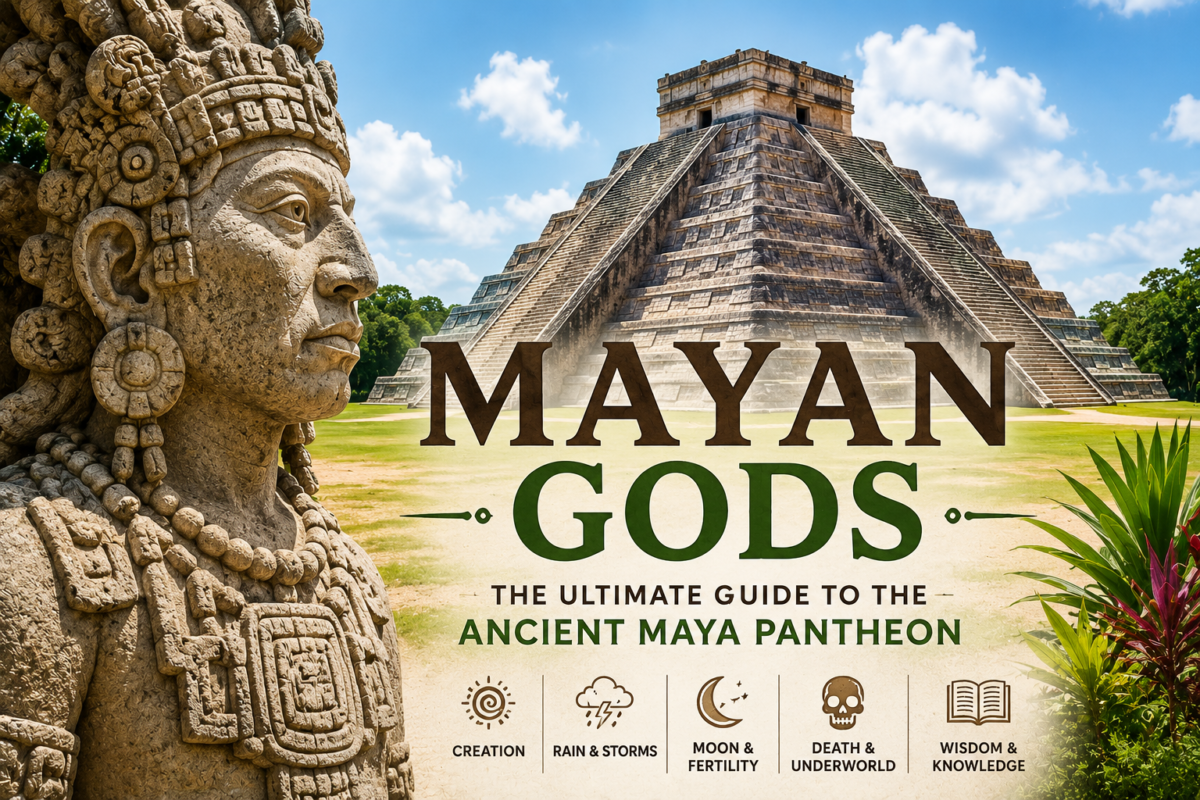
Few ancient civilisations captured the imagination of the world quite like the Maya. Hidden deep in the jungles of Mesoamerica, they built towering temples, developed one of the world’s most sophisticated calendars, and created a rich, complex mythology populated by hundreds of gods and supernatural beings. If you’ve ever been curious about Mayan gods, who they were, what they ruled, and why they still matter today, this is the most comprehensive guide you’ll find. From the supreme creator Itzamna to the feathered serpent Kukulkan, let’s journey into the divine world of the ancient Maya.
Who Were the Ancient Maya?
The Maya civilisation flourished across Mesoamerica from around 300 BC until the Spanish conquest in the early 1500s AD, spanning the regions of present-day Mexico (Yucatan, Chiapas, Tabasco), Guatemala, Belize, Honduras, and El Salvador. At its height, Maya society was one of the most advanced in the ancient world, with extraordinary achievements in:
- Architecture: including massive pyramid temples like Chichen Itza and Tikal
- Mathematics: including the development of the concept of zero
- Astronomy: including precise tracking of celestial cycles
- Writing: including one of the few fully developed writing systems of the ancient Americas
- Religion: including a deeply complex pantheon of over 150 to 200 gods
Religion was not separate from daily life for the Maya. It was the foundation of everything. Farming, medicine, warfare, trade, birth, and death were all governed by divine forces.
How Many Mayan Gods Were There?
The Maya pantheon is vast. Historians estimate there were over 150 to 200 distinct deities, though some sources suggest the number could be even higher when regional variations and alternate names are included. One comprehensive database lists 299 recorded Maya deity names across 93 core individual gods.
A few important things to know about Mayan gods:
- Many gods had overlapping roles and were not confined to a single domain
- The same deity could appear in multiple forms: human, animal, or hybrid
- Gods could be both benevolent and destructive depending on the season, ritual, or calendar cycle
- Many Mayan gods are connected to specific numbers, colours, and cardinal directions
- The gods were actively worshipped through offerings, bloodletting rituals, and human sacrifice
The Most Important Mayan Gods and Goddesses
1. Itzamna: The Supreme Creator
Itzamna is widely regarded as the most important god in the Maya pantheon. He was the ruler of heaven, day, and night, and the supreme creator deity who shaped the world. Often depicted as an elderly man with a toothless mouth and large nose, Itzamna was:
- The inventor of writing and books
- The patron of learning, arts, and sciences
- The one who taught humans to grow maize, use calendars, and practise medicine
- The lord who divided the land among the Maya people
He was considered largely kind and protective toward humans, making him one of the most revered figures in all of Maya religion.
2. Kukulkan: The Feathered Serpent
Known as Kukulkan in the Yucatan and Quetzalcoatl in Aztec tradition, this feathered serpent deity is arguably the most recognisable of all Mayan gods. His image appears extensively across major archaeological sites, most famously in the pyramid El Castillo at Chichen Itza, where during the spring and autumn equinoxes, a shadow of a serpent descends the pyramid’s staircase.
Kukulkan represented:
- The union between Earth and sky
- Wind, air, and divine knowledge
- Resurrection and reincarnation
- The four elements: earth (maize), water (fish), fire (lizard), and air (vultures)
He was a supreme god worshipped from the highlands of Guatemala to the Yucatan Peninsula, making him one of the most geographically widespread Maya deities.
3. Chaac: God of Rain and Storms
For an agricultural civilisation dependent on seasonal rainfall, Chaac was one of the most practically important gods of all. He was the god of rain, storms, thunder, and lightning, and his favour was essential for successful harvests.
- Depicted with scales, a curling reptilian snout, and serpent fangs
- Carried a serpent as a symbol of lightning
- Particularly venerated in the Yucatan region, where his image is found all over Chichen Itza
- Worshipped through elaborate rain ceremonies and offerings
Chaac was so important that the Maya often performed Chaac rituals at the beginning of the planting season, praying for adequate rainfall to feed their crops.
4. Ix Chel: Goddess of the Moon and Healing
Ix Chel (also written as Ixchel) is one of the most complex and multifaceted goddesses in Maya mythology. She was associated with the moon, fertility, childbirth, healing, water, weaving, and rainbows.
- Wife of Itzamna and mother of many gods
- Depicted wearing a serpent headdress and a skirt decorated with bones
- Guardian of women during childbirth
- Patron of medicine and midwifery
- Her sacred island of Cozumel, off the Yucatan coast, was a major pilgrimage site
She had a dual nature: in her young form, she represented fertility and the gentle rain; in her older form, she was associated with floods and catastrophe.
5. Ah Puch: Lord of Death and the Underworld
Ah Puch (also known as Cizin or Kisin, meaning “the stinking one”) was the dreaded ruler of Xibalba, the Maya underworld. Among the most feared of all Maya deities, he was:
- Depicted as a decomposing body or skeleton adorned with bells
- God of death, darkness, and disaster
- Also paradoxically associated with childbirth and new beginnings
- Ruler of the lowest and most terrible level of the underworld
In Maya belief, the underworld Xibalba was populated by terrifying death gods and demons, and the dead had to pass through a series of trials to reach their final resting place.
6. Hunahpu and Xbalanque: The Hero Twins
The Hero Twins are central figures in the Maya creation epic, the Popol Vuh. Their story of defeating the lords of the underworld is one of the most compelling narratives in all of Maya mythology.
- Hunahpu and Xbalanque were skilled ballplayers and tricksters
- They were summoned to Xibalba after their father was killed by the death lords
- Through cunning and supernatural skill, they defeated the gods of Xibalba
- They ultimately ascended to the sky, becoming the Sun and the Moon (or the Sun and Venus)
The Hero Twins myth is widely interpreted as a metaphor for the cycle of life, death, and rebirth, deeply tied to the agricultural calendar.
7. Huracan: God of Wind and Storms
Huracan was one of the creator gods who played a key role in the formation of the world as described in the Popol Vuh. His name is the direct origin of the English word “hurricane.”
- Also called “Heart of Sky”
- One of three creator gods alongside Tepeu and Gucumatz
- Sent floods to destroy failed versions of humanity before the current world was made
- Associated with lightning, wind, and storms
8. Yum Kaax: God of Wild Vegetation and the Hunt
Often misidentified as purely a maize god, Yum Kaax was more accurately the deity of wild vegetation, forests, and animals. He was:
- Popular with hunters, who believed he could guide arrows for a successful hunt
- Associated with the natural world and wilderness
- Often depicted as a young man with a maize plant growing from his head
- A symbol of the abundance and unpredictability of the natural world
9. Kinich Ahau: The Sun God
Kinich Ahau was the radiant sun god and patron of music and poetry. He was a powerful and prominent deity because the sun’s movement governed the Maya calendar and daily life.
- Often depicted as a man with a hooked nose, crossed eyes, and filed teeth
- Travelled across the sky during the day
- Descended into the underworld at night, transforming into a jaguar god
- Sometimes incarnated as a ruler, giving kings divine authority
- Another solar manifestation, Kinich Kakmo, appeared as a fiery macaw
10. Ek Chuaj: God of Cacao and Trade
Ek Chuaj was the patron deity of merchants, travellers, and the cacao harvest. Given that cacao beans served as currency and a precious commodity in Maya trade networks, his importance was enormous.
- Depicted as a dark-skinned figure carrying a satchel and spear
- Honoured by merchants before long journeys
- Also associated with warfare and conflict
- His festival was celebrated each month of Muan with cacao offerings
11. Camazotz: The Bat God
Camazotz is one of the most chilling figures in Maya mythology. His name literally translates to “death bat,” and he was a terrifying supernatural being who dwelled in the underworld.
- Featured in the Popol Vuh as a monster who decapitates Hunahpu
- Associated with darkness, death, and the nocturnal world
- Depicted as a large bat with a human body
- Still remembered today through the leaf-nosed bat species named after him, Desmodus draculae
12. Hunab Ku: The Supreme Abstract Deity
Hunab Ku is the most abstract and philosophical of all Maya gods, representing the concept of a singular, all-encompassing supreme deity.
- His name translates to “the one living god” or “sole god”
- Considered the father of Itzamna
- No physical depictions exist from the pre-colonial period, suggesting he was too abstract to be represented
- Some historians believe his concept was strengthened during the Spanish colonial period to align Maya religion with Christian monotheism
Mayan Gods Quick Reference Table
| God | Domain | Key Symbol |
|---|---|---|
| Itzamna | Creation, wisdom, sky | Serpent, writing tools |
| Kukulkan | Wind, knowledge, resurrection | Feathered serpent |
| Chaac | Rain, storms, agriculture | Lightning axe, reptile scales |
| Ix Chel | Moon, healing, fertility | Serpent headdress, bones |
| Ah Puch | Death, underworld | Skeleton, bells |
| Huracan | Wind, storms, creation | Three lightning bolts |
| Kinich Ahau | Sun, music, power | Jaguar, solar disc |
| Ek Chuaj | Trade, cacao, merchants | Satchel, spear |
| Yum Kaax | Wild vegetation, hunt | Maize plant |
| Camazotz | Death, darkness, bats | Bat wings |
| Hunab Ku | Supreme abstract deity | Circle with motion symbol |
The Maya Underworld: Xibalba
No guide to Mayan gods would be complete without understanding Xibalba (pronounced shee-bal-ba), the terrifying Maya underworld. The word means “place of fear” in the K’iche’ Maya language.
Xibalba was ruled by a council of twelve death gods, including Ah Puch, Hun Came (“One Death”), and Vucub Came (“Seven Death”). It consisted of multiple levels, each containing a different type of suffering:
- Dark House: where total darkness prevailed
- Cold House: filled with icy winds
- Razor House: full of cutting blades
- Hot House: with searing heat
- Bat House: filled with deadly bats (home of Camazotz)
The dead had to navigate this terrifying realm before reaching their final resting place. Only those who died in battle, in childbirth, or through sacrifice were believed to go directly to paradise.
The Popol Vuh: The Maya Bible
The Popol Vuh is the most important surviving text of Maya mythology, written by the K’iche’ Maya of Guatemala in the 16th century after the Spanish conquest. It contains:
- The story of creation and the formation of the world
- The adventures of the Hero Twins Hunahpu and Xbalanque
- The origins of maize and humanity (humans were said to be made from maize dough)
- Accounts of the gods of Xibalba
- The creation and destruction of multiple failed versions of humanity before the current one
The Popol Vuh remains one of the most significant works of pre-Columbian literature and continues to be studied by scholars worldwide.
Mayan Gods vs Aztec Gods
Many people confuse Mayan and Aztec mythology, but while there is some overlap, they are distinct:
| Aspect | Maya | Aztec |
|---|---|---|
| Location | Yucatan, Guatemala, Belize | Central Mexico |
| Feathered Serpent | Kukulkan | Quetzalcoatl |
| Rain God | Chaac | Tlaloc |
| Death God | Ah Puch / Cizin | Mictlantecuhtli |
| Sun God | Kinich Ahau | Tonatiuh |
| Key Text | Popol Vuh | Aztec Codices |
| Civilisation Peak | 250 to 900 AD (Classic Period) | 1300 to 1521 AD |
Both civilisations share Mesoamerican religious traditions, including a focus on agricultural cycles, human sacrifice, and a layered cosmos of heavens, earth, and underworlds.
Mayan Gods in Modern Culture
The influence of Maya mythology extends powerfully into modern popular culture:
- Kukulkan appears in video games, films, and comics as a powerful serpent deity
- Camazotz was adapted into the villain of Madeleine L’Engle’s novel A Wrinkle in Time
- Huracan directly gave English the word “hurricane.”
- The Maya calendar and its connection to Maya gods became a global phenomenon in 2012 during the supposed “end of the world” predictions
- Maya gods appear extensively in video games like Civilization, Overwatch, and Smite
- Archaeological sites like Chichen Itza, dedicated to Kukulkan, remain among the most visited ancient monuments in the world
Where to Experience Mayan Mythology Today
If you want to go beyond books and experience Maya mythology in person:
- Chichen Itza, Mexico: the pyramid of Kukulkan with its famous equinox shadow display
- Tikal, Guatemala: towering jungle temples dedicated to various deities
- Palenque, Mexico: tomb of the great ruler Pakal, rich in Maya iconography
- Cozumel Island, Mexico: historically a pilgrimage site for Ix Chel worship
- The National Museum of Anthropology, Mexico City: the world’s finest collection of Maya and Aztec artefacts
- Uxmal, Mexico: elaborate stone carvings of Chaac’s face cover nearly every surface
Safety and Respect When Visiting Maya Sites
When visiting archaeological sites associated with Mayan gods:
- Respect local customs: as many Maya communities still practise traditional ceremonies and consider these sites sacred
- Do not remove artefacts or stones: as this is illegal and deeply disrespectful
- Follow guided tour rules: at restricted areas within sites like Chichen Itza
- Learn basic Maya history: before visiting, as context enriches the experience enormously
- Support local Maya communities: by choosing indigenous-run tours and artisan markets
Frequently Asked Questions on the Mayan god
Who is the most powerful Mayan god?
Itzamna is generally considered the most powerful and important deity in the Maya pantheon. As the ruler of heaven, day, and night, and the supreme creator, he sat at the top of the divine hierarchy. Hunab Ku is sometimes cited as the ultimate supreme being, though he is more abstract and philosophical.
Who is the Mayan god of death?
The primary Mayan god of death is Ah Puch (also known as Cizin or Kisin). He ruled Xibalba, the underworld, and was depicted as a skeletal or decomposing figure adorned with bells. A council of twelve death gods ruled Xibalba alongside him.
What did the Maya believe about the afterlife?
The Maya believed in a multi-layered cosmos with thirteen heavens and nine levels of the underworld (Xibalba). Most souls descended to Xibalba after death and had to navigate terrifying trials. Those who died in battle, childbirth, or sacrifice were believed to ascend directly to paradise without enduring Xibalba.
Is Kukulkan the same as Quetzalcoatl?
They are closely related but not identical. Kukulkan was worshipped by the Yucatec Maya, while Quetzalcoatl was the Aztec name for a very similar feathered serpent deity. Both represented wind, knowledge, and the connection between heaven and earth, and scholars believe the concept spread across Mesoamerican cultures over centuries.
What is the Popol Vuh?
The Popol Vuh is the sacred creation text of the K’iche’ Maya, written down in the 16th century. It contains the Maya creation story, the adventures of the Hero Twins, and accounts of the gods of the underworld. It is the most important surviving piece of pre-Columbian Maya literature.
Did the Maya practise human sacrifice?
Yes. Human sacrifice was an important part of Maya religious practice, carried out to honour and appease gods like Chaac, Ah Puch, and others. Sacrifices were made during major ceremonial events, droughts, and astronomical milestones. The practice was not as widespread as in Aztec society, but it was significant.
How many gods did the Maya have?
Historians estimate the Maya worshipped between 150 and 200 distinct deities, though with regional variations and alternate names, the total number of recorded deity names exceeds 299.
Are there any living Maya today?
Yes. There are approximately 7 to 8 million Maya people living today across Mexico, Guatemala, Belize, Honduras, and El Salvador. Many communities continue to practise elements of traditional Maya spirituality alongside Christianity.
