
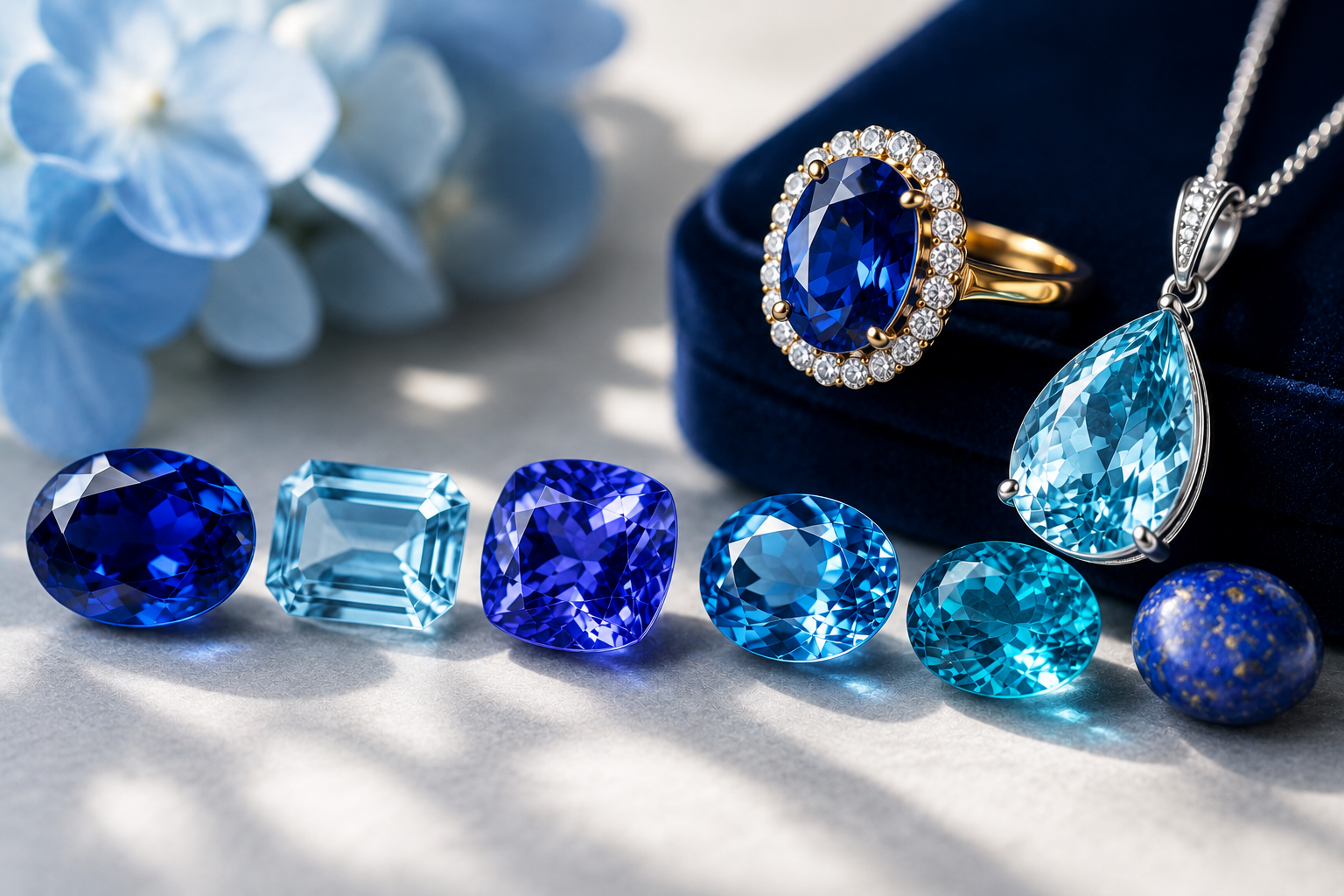
Blue gemstones captivate with hues evoking serene oceans, twilight skies, and tranquil depths. From the royal prestige of sapphire to the vibrant rarity of Paraíba tourmaline and the mystical appeal of lapis lazuli, they offer options across budgets, styles, and purposes, whether for engagement rings, spiritual practices, investments, or everyday wear.
This comprehensive guide merges the best insights on popular and rare blue gemstones, their physical properties, origins, symbolic meanings, comparisons, buying tips, and care instructions. All information is grounded in established gemological facts.
Why Blue Gemstones Endure in Popularity
Blue symbolizes trust, peace, wisdom, loyalty, and clear communication. In crystal healing and chakra traditions, blue stones align with the throat chakra, supporting emotional balance, reduced anxiety, honest expression, and serenity. While these metaphysical benefits lack scientific proof, they add personal significance for many wearers.
Practically, blue gems complement most skin tones and metals (silver, gold, rose gold). They feature in timeless classics and modern trends, from solitaire rings to layered necklaces and bold statement pieces.
Top Blue Gemstones: Properties, Origins, and Details
Blue Sapphire
The premier blue gemstone is a variety of corundum (alongside ruby). Colors range from light cornflower to deep royal or velvety “Kashmir” blue. Mohs hardness: 9 (extremely durable). High refractive index and brilliance.
- Origins: Kashmir (India; historically finest), Sri Lanka (Ceylon), Myanmar, Madagascar, Australia, Thailand.
- Value: Natural, untreated high-quality stones reach thousands per carat; top specimens are investment-grade.
- Treatments: Heat treatment is common and accepted to enhance color and clarity.
- Meaning and Symbolism: Wisdom, loyalty, protection, divine favor; historically linked to royalty.
- Best For: Engagement rings, heirloom jewelry, daily wear.
- Birthstone: September.
Aquamarine
A blue-to-blue-green variety of beryl (same family as emerald). Soft sea-water hues. Mohs hardness: 7.5–8. Good durability for everyday use.
- Origins: Primarily Brazil; also Nigeria, Madagascar, and Zambia.
- Value: More affordable than sapphire; larger, high-clarity stones are accessible.
- Meaning: Courage, serenity, clear communication; evokes ocean calm.
- Best For: Everyday jewelry, gifts for water signs (Pisces, Cancer, Scorpio), birthstone pieces.
- Birthstone: March.
Tanzanite
A trichroic variety of zoisite, shifting between blue, violet, and burgundy. Intense blue-violet after treatment. Mohs hardness: 6–7 (somewhat softer; best in protective settings).
- Origins: Almost exclusively Merelani Hills, Tanzania (one major source; increasing rarity).
- Value: Medium to high; rarer than many blues but more affordable than top sapphires.
- Treatments: Heat treatment standard to remove brown tones and enhance blue-violet.
- Meaning: Transformation, spiritual growth, intuition.
- Best For: Unique statement jewelry, pendants, and earrings.
- Birthstone: December (one of several).
Blue Topaz
Ranges from sky blue to Swiss blue to deep London blue. Mohs hardness: 8. High clarity and brilliance.
- Origins: Natural blue rare; most from Brazil, Sri Lanka, etc., but treated.
- Value: Very affordable; excellent for large stones.
- Treatments: Nearly all commercial blue topaz is irradiated and heat-treated (standard industry practice; stable).
- Meaning: Calm, clarity, joy, creativity.
- Best For: Bold designs, beginners, large statement pieces.
- Birthstone: November (blue popular year-round; also December option).
Blue Spinel
Vivid blue (sometimes cobalt-like), often mistaken for sapphire. Mohs hardness: 8. Excellent brilliance and durability.
- Origins: Sri Lanka, Myanmar, Tanzania, Vietnam.
- Value: Medium; more affordable than comparable sapphires.
- Meaning: Energy, protection, resilience.
- Best For: Sapphire alternative in rings and daily wear.
Paraíba Tourmaline
Electric neon blue to blue-green, caused by copper. Mohs hardness: 7–7.5. Extraordinary rarity and “neon” glow.
- Origins: Paraíba, Brazil (original); also Nigeria, Mozambique.
- Value: Extremely high (thousands to tens of thousands per carat); one of the rarest gems.
- Meaning: Joy, vitality, inspiration.
- Best For: High-end collector pieces, investment.
Other Notable Blue Gemstones
- Blue Zircon: High fire and brilliance (higher dispersion than diamond). Mohs ~7.5. December birthstone option. Often heat-treated.
- Iolite (Water Sapphire): Pleochroic (color shifts), affordable. Mohs 7–7.5.
- Lapis Lazuli: Deep blue with pyrite flecks (opaque). Ancient use in art/jewelry. Mohs 5–6 (softer).
- Larimar: Rare blue pectolite from the Dominican Republic, ocean-like patterns. Mohs ~4.5–5 (delicate).
- Blue Diamond: Extremely rare (boron impurities). Mohs 10. Most expensive. Symbolizes eternal strength.
- Blue Tourmaline (Indicolite): Vibrant, rare. Mohs 7–7.5.
- Kyanite: Blade-like crystals, striking blue. Mohs 4.5–7 (variable).
- Others: Blue spinel variants, apatite (softer), turquoise (Mohs 5–7, porous), azurite.
Blue Gemstones Comparison Table
| Gemstone | Mohs Hardness | Price Range | Key Feature | Ideal Use | Common Treatments |
|---|---|---|---|---|---|
| Blue Sapphire | 9 | High | Prestige, durability | Engagement rings | Heat |
| Blue Diamond | 10 | Very High | Hardness, rarity | Investment, heirlooms | Rare/none |
| Blue Spinel | 8 | Medium | Brilliance, sapphire alt. | Daily rings | Minimal |
| Blue Topaz | 8 | Low | Affordability, size | Bold/statement pieces | Irradiation + heat |
| Aquamarine | 7.5–8 | Medium | Serene color | Everyday wear | Heat (mild) |
| Paraíba Tourmaline | 7–7.5 | Very High | Neon vibrancy, rarity | Collector pieces | Minimal |
| Tanzanite | 6–7 | Medium-High | Color shifting | Statement/occasional | Heat |
| Lapis Lazuli | 5–6 | Low-Medium | Historical, opaque | Beads, inlays | None/sealing |
Healing Properties and Symbolic Meanings
Blue gems are linked to:
- Emotional: Soothing anxiety, promoting peace and balance.
- Communication: Enhancing truth, clarity, and self-expression.
- Physical (traditional): Throat, thyroid, eyes, and respiratory support.
- Spiritual: Wisdom, intuition, transformation (especially tanzanite, iolite).
These are cultural and anecdotal traditions, not medical facts.
How to Choose and Buy Blue Gemstones
- Prioritize Durability: Mohs 7.5+ for rings (sapphire, spinel, topaz, aquamarine). Softer stones (tanzanite, lapis, larimar) suit pendants/earrings with protective settings.
- Evaluate Color and Clarity: Even distribution, eye-clean preferred. The depth of blue varies by personal taste.
- Understand Treatments: Common and disclosed for sapphire, tanzanite, and topaz. Ask for details.
- Demand Certification: GIA or equivalent for valuable stones (>1–2 carats).
- Budget and Style: Topaz/zircon for value; sapphire/spinel for longevity; Paraíba for rarity.
- Ethical and Responsible Sourcing: Seek sellers with transparent supply chains.
- Verify Authenticity: Natural inclusions vs. too-perfect synthetics; use reputable dealers.
Care Instructions: Clean with mild soap/water and a soft brush. Avoid harsh chemicals and ultrasonics for softer stones. Store separately. Tanzanite and lapis need extra caution (avoid heat/impacts). Re-polish or re-treat as needed professionally.
Blue Gemstones in Modern Jewelry Trends
Blue gems excel as diamond alternatives in engagement rings (sapphire famous from royal history)—aquamarine and topaz suit “something blue” weddings. Mixed blue layers, mixed-metal designs, and birthstone personalization are popular. Paraíba and spinel appeal to collectors seeking uniqueness.
Frequently Asked Questions about Blue Gemstones
Most expensive blue gemstone?
Blue diamonds, followed by top Kashmir sapphires and Paraíba tourmaline.
Best for engagement rings?
Blue sapphire (durability + symbolism). Spinel and aquamarine are strong alternatives.
Suitable for daily wear?
Yes for sapphire, spinel, and topaz. Protective settings for tanzanite.
How to tell real vs. fake?
Natural inclusions, certification, refractive index tests; buy from trusted sources.
Symbolism summary?
Peace, wisdom, loyalty, communication, serenity.
